Microservices Architecture: Advanced Scalability and Data Consistency Strategies in Distributed Systems
Discover advanced scalability and data consistency strategies in microservices. Learn about the Saga Pattern, gRPC, Redis Pub/Sub, and database migration.
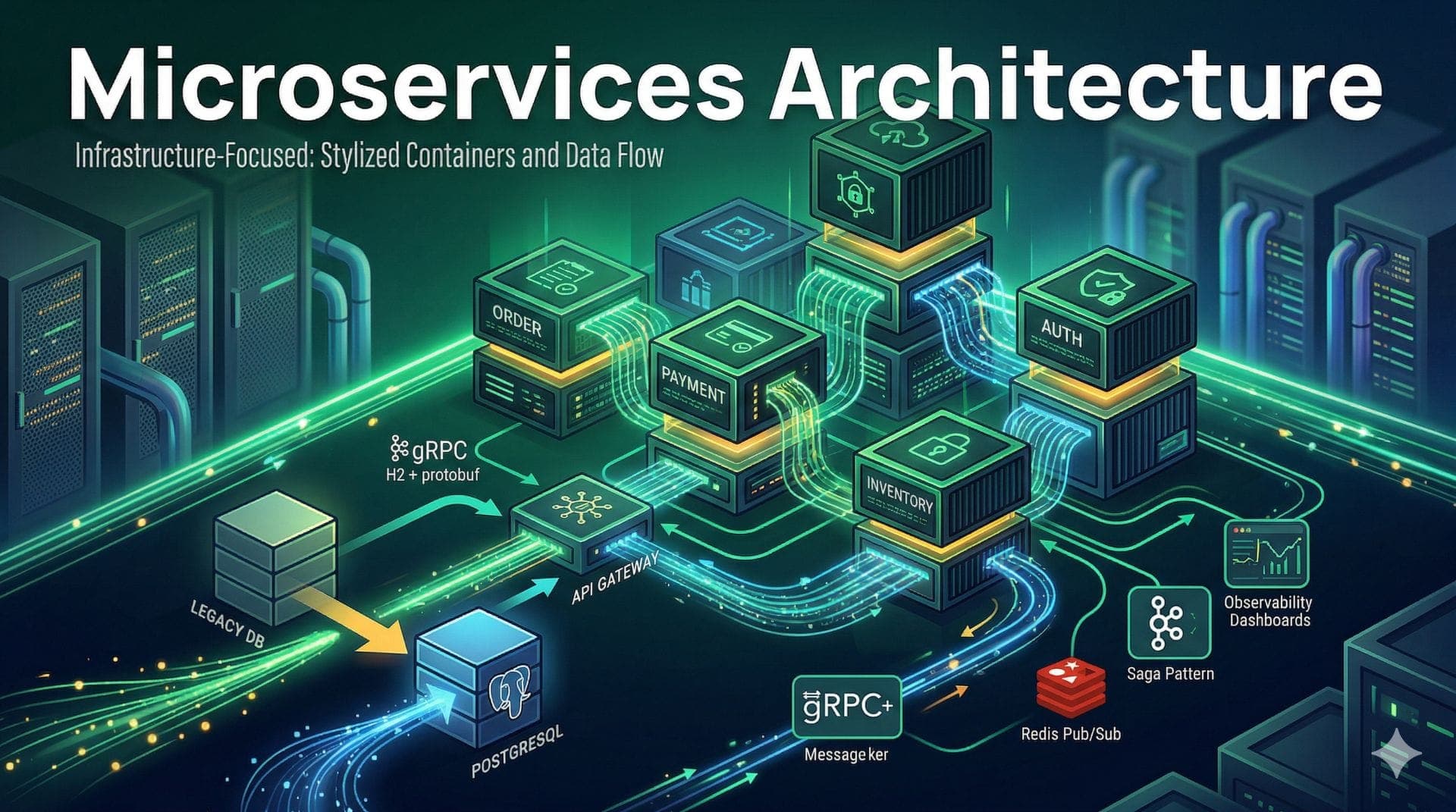
Microservices architecture accelerates the software lifecycle by dividing large-scale applications into independent, scalable, and independently deployable services. However, transforming a monolithic structure into a distributed ecosystem significantly increases operational complexity. Network partition tolerance, inter-service security, and most importantly, state management, must be at the center of architectural decisions.
Distributed Data Consistency and Migration Strategies
The traditional ACID guarantees found in monolithic structures become inapplicable with the "Database-per-Service" principle, which is the golden rule of microservices. To manage distributed transactions, the Saga Pattern provides a robust solution. Implemented through choreography or orchestration approaches, Saga, when combined with Event Sourcing, securely stores not just the current state of the data, but the entire history of mutations (events) that led to that state.
In practice, microservice transformations often involve infrastructure modernization. For instance, migrating from a legacy MSSQL database to a more flexible and cost-effective PostgreSQL database requires critical engineering effort. During these migrations, utilizing automation tools like pgloader, high precision is required, especially in data type transformations (such as seamlessly mapping legacy guid values to native uuid types in the new system) to maintain data integrity.
Inter-Service Communication and Distributed Cache Consistency
Network-based service communications are potential bottlenecks of the system. For internal communications requiring low latency, gRPC, running over HTTP/2 with binary serialization via Protobuf, is becoming the standard. For asynchronous and decoupled architectures, utilizing Event-Driven design patterns and Message Brokers (Kafka, RabbitMQ) is essential.
Caching is vital to maximize system performance. However, in scenarios where multiple distinct microservices (like A, C, D, E, and F) fetch, process, and aggregate data, ensuring "distributed cache consistency" is a challenging problem. The moment data is updated in one service, another service (for example, service B) that relies on that data must be able to fetch the most up-to-date version instantly. For such real-time synchronization needs, an architecture utilizing Redis Pub/Sub can be implemented; data mutations in any microservice are instantly published to relevant subscribers, ensuring the cache is invalidated and updated, preventing stale data reads.
Observability and API Gateway
In an environment running hundreds of containers, traditional logging is insufficient to isolate errors and monitor system health. With Distributed Tracing (Jaeger, Zipkin), the entire journey of an HTTP request across microservices can be tracked, while Centralized Logging (ELK/EFK Stack) correlates distributed logs in a single hub. A robust API Gateway, which routes client requests to appropriate services, enforces rate-limiting, and manages authentication mechanisms, acts as the single, controlled entry point of this complex architecture to the outside world.

MUHAMMED EMİN SUBAŞI
Muhammed Emin Subaşı is a Senior Software Engineer and content creator specializing in modern web technologies, cloud computing, and user experience design. He aims to share technically deep yet accessible guides for developers and tech enthusiasts.